Between technical acronyms, manufacturer-specific dimensions, and fluctuating payload capacity, choosing a van can feel more like guessing. And getting it wrong is costly. You are faced with multiple trips, struggling with narrow residential streets, and simply being unable to load your cargo in the van.
Fortunately, this complete van size comparison guide addresses all areas of confusion. So you can make an informed decision about your van hire or purchase.
What Do Van Sizes Mean?
In the context of van sizes, L is length, and H refers to height. The higher the number that follows, the longer or taller the cargo area is. As standard:
| L1 = Short (2.5m) | L2 = Medium (2.9m) | L3 = Long (3.5m) | L4 = Extra Long (3.9m) |
| H1 = Standard (1.4m-1.65m) | H2 = High Roof (1.7m) | H3 = Super High Roof (1.8m) |
Essential Information: Two vans can suit the L2 categorisation, but be of different physical lengths.
Why?: The actual dimensions of a van are manufacturer-dependent and can fluctuate.
Importance: Compare real van measurements; the standard sizing is only a guide.
.
What are the Different Types of Vans?
- SWB – Short Wheelbase – Ideal for small business owners navigating city centres and narrow roads.
- MWB – Medium Wheelbase – Ideal for commercial use. Provides ample space and manoeuvrability.
- LWB – Long Wheelbase – Ideal for couriers and removals companies transporting large loads.
- XLWB – Extra Long Wheelbase – Ideal for businesses requiring maximum cargo volume.
- Luton Box Vans – Ideal for residential removals and transporting large volumes.
- 7.5 Tonne Box Van – Ideal for commercial logistics, requires a specialised license.
- Low Loader– Ideal for oversized cargo. Features a lower floor height for loading, without a tail lift.
What Types of Loads Can Every Type of Van Fit?
- SWB – Boxes of small objects, potentially a few larger appliances.
- MWB – Standard pallets and equipment.
- LWB – Items over 3m long (sofas, pipes, etc.)
- XLWB – Large appliances and furniture for major house moves.
- Luton Box Vans – Upright furniture and appliances.
- 7.5 Tonne Box Van – Commercial inventory or residential relocations.
- Low Loader – Heavy, bulky items or white goods that require a walk-in loading height.
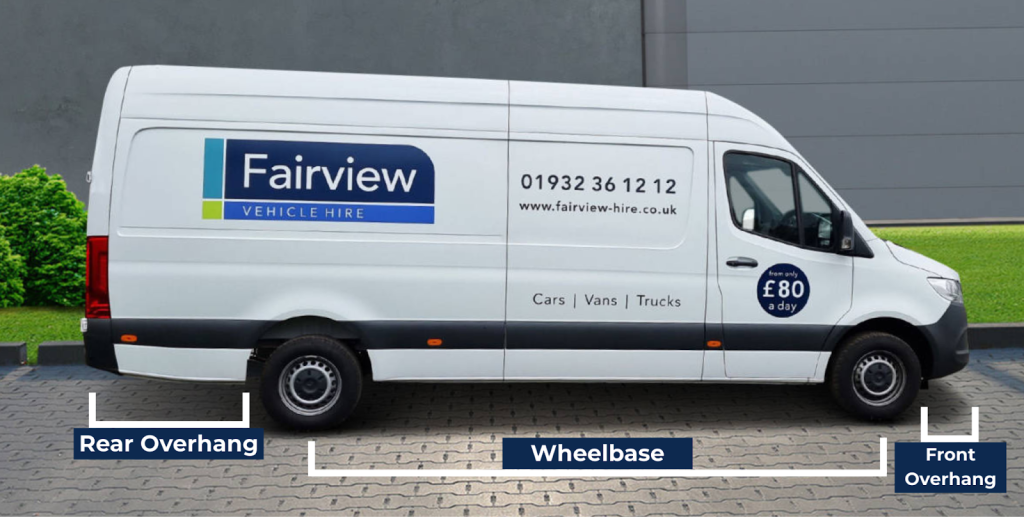
What is a Van’s Wheelbase?
A van’s wheelbase is the distance between the centres of the front and rear wheels. It determines three critical factors:
- The length of the interior cargo area – A longer wheelbase equals a longer load floor.
- The overhang and tail swing – A short wheelbase creates a long overhang and a large tail swing.
- Manoeuvrability and stability – Short wheelbases are easier to drive, long wheelbases are smoother.
Base your choice of van on the activities you will use it for. An XLWB will struggle more on residential roads, but an SWB will not support a large-scale house move. The dimensions of the cargo area and payload will not allow for it.
What is the Difference Between WB Vans and Box Vans?
| Feature | WB / Panel Van | Box / Luton Van |
| Cargo Shape | Curved with wheel arches. | Perfectly square and flat. |
| Ideal for | Couriers, trades and pallets. | House moves and large furniture. |
| Loading | Side and rear access. | Rear access, usually with a tail lift. |
| Storage | Floor space only. | Floor and over-cab compartment. |
| Ease of Driving | High (similar to a car). | Moderate (requires height awareness). |
The main difference between WB and Box / Luton vans is their body structure and the shape of their cargo area.
Floor Space
- The floor space of Box / Luton vans is flat. So you can push furniture and pallets against the walls.
- WB / Panel vans have curved walls and internal wheel arches that protrude into the floor space.
Wheel arches significantly influence the internal load width of your van. Although it may read 1.8m overall, the wheel arches could reduce it to 1.2m. So, assess the actual internal load width before buying or hiring a van.
Loading and Accessibility
- Luton vans sit high above the ground and require an electric tail lift for loading.
- Low-Loaders are built closer to the ground. So you can walk straight into the cargo area.
- WB / Panel vans have a step-in height, making them easy for couriers to use quickly.
Head Space
- Box / Luton vans include a compartment over the driver’s cab for extra storage.
- WB / Panel vans do not utilise over-cab storage.
Driving Requirements
- Box / Luton vans are susceptible to side winds and drag head-on due to their boxy shape.
- WB / Panel vans are easier to drive in high winds and have better fuel efficiency as a result.
Height Hazards
- Box / Luton H2s and H3s will not fit in standard car parks; extra route planning may be necessary.
- WB / Panel vans are less vulnerable to external height restrictions.
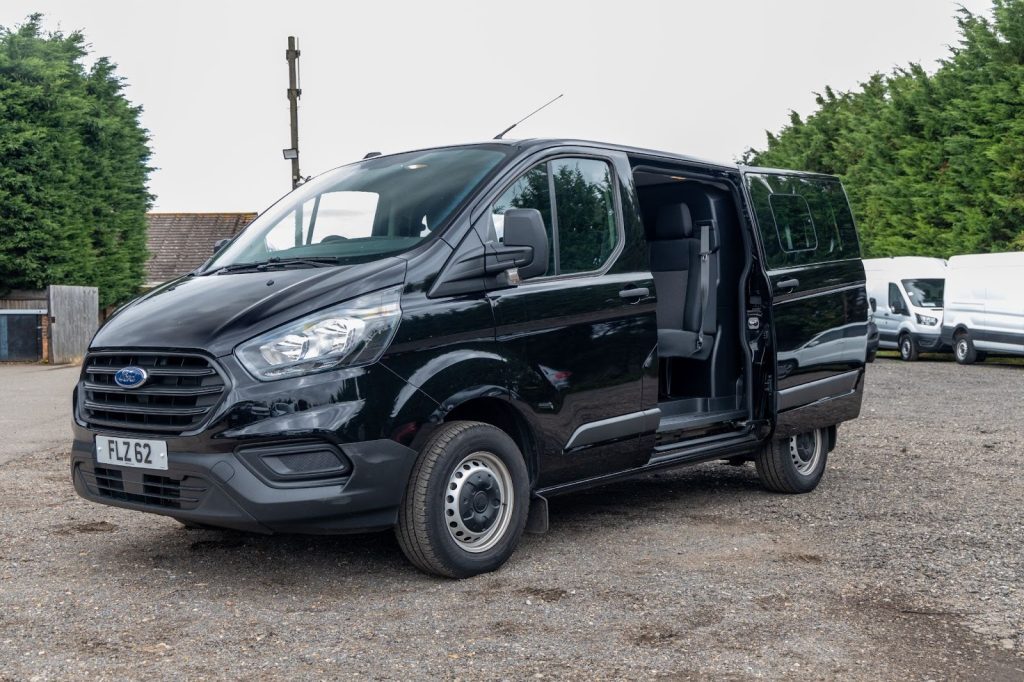
What is a Crew Cab Van?
A crew cab van is a hybrid vehicle that combines the seating capacity of a car (5-6) with the cargo space of a commercial van. In appearance, it is a standard panel van, but it includes an extra row of seats behind the driver. It also has a fixed bulkhead to protect passengers from shifting cargo.
Crew cab vans are most commonly available as MWBs and LWBs to account for the cargo space. They are ideal for:
- Site Teams – Requiring transport for a team and tools.
- Active Families – Needing space for a large group and a separate area for dirty gear.
- Exhibitions / Events – Needing to transport a crew and materials.
MWB Crew Cab Vans provide a cargo area similar in size to a small car’s boot.
LWB Crew Cab Vans retain rear floor space suitable for a standard pallet, making them better for professional use.
Essential Information: The internal load length is often shorter than that of a standard van with the same wheelbase.
Why? The second row of seats occupies the front portion of what would have been the cargo area.
Importance: Consider whether transporting a group at once is a priority over cargo space.
.
What Does Payload Mean on a Van?
A van’s payload is the maximum weight it can carry, covering everything and everyone inside of it. Staying within the specified payload of your van is crucial to comply with the law.
To calculate the payload of your van, follow this formula:
Gross Vehicle Weight (GVW) – Kerb Weight = Payload
.
What is the Gross Vehicle Weight of a Van?
The Gross Vehicle Weight (GVW) of a van is the maximum your van is legally allowed to weigh when fully loaded. For most standard vans (SWB / MWB), this is 3,500kg.
What is the Kerb Weight of a Van?
The kerb weight of a van includes the weight of the van itself, including fuel and fluids, with nothing else in it.
What is Included in a Van’s Payload?
A van’s payload includes:
- The driver and all passengers.
- Personal items (tools, equipment, and even lunch!)
- The fuel in the tank.
Essential Information: Just because a van is bigger, it does not mean it can carry more weight.
Why? The wheelbase of an LWB is made of more metal, therefore, heavier.
Importance: Even if a SWB and LWB have the same 3,500kg legal limit, the LWB will likely have less payload.
.
What Happens if I go Over My Van’s Payload?
If you exceed your van’s payload:
You may receive a fine from the DVSA. They can stop and weigh vehicles at random, so it is better to be safe than sorry by staying within the payload limit.
Your insurer may invalidate your cover if you have an accident while driving an overweight vehicle.
Your van may become unstable while turning corners and take much longer to stop. This puts extreme stress on your tyres and suspension, and could cause an accident.
What are the Van Speed Limits in the UK?
The speed limits for most vans in the UK are 10mph lower than those for cars on certain types of roads. However, there are further fluctuations between car-derived vans and dual-purpose vehicles, which depend on their weight. You must understand the fluctuations in speed limits when hiring or purchasing a van to ensure you drive legally and safely.
For Standard Vans up to 3.5 Tonnes (SWB / LWB / Luton Models)
| Road Type | Cars and Motorbikes | Vans up to 3.5T |
| Areas With Streetlights | 30mph (20mph in Wales) | 30mph (20mph in Wales) |
| Single Carriageways | 60mph | 50mph |
| Dual Carriageways | 70mph | 60mph |
| Motorways | 70mph | 70mph |
For Vans That Weigh Less Than 2 Tonnes
A small number of vans that weigh less than 2 tonnes are allowed to follow standard car speed limits. These rules apply because they are classed as Car-Derived Vans. You can determine whether your van is in this category by referencing the vehicle logbook. There, the CDV category is explicitly stated.
For Dual-Purpose Vehicles (Crew Cab Vans and Pickups)
If the unladen weight of your crew cab van or pickup is under 2,040kg, you can follow car speed limits. However, if the unladen weight is above 2,040kg, you must follow van speed limits.
For Vans Towing a Trailer
If you are towing a trailer with your van, the motorway speed limit reduces from 70mph to 60mph. Additionally, you can not use the right-hand lane on a motorway with three or more lanes.
Essential Information: Vans weighing over 3.5 tonnes must (by law) be fitted with a speed limiter.
Why? For safety, the speed limiter prevents the van from exceeding 56mph or 60mph.
Importance: If you are purchasing a van over 3.5 tonnes, this information is vital.
.
Need Further Guidance on Van Sizes?
If you are looking to hire or purchase a van but are still unsure about the size you need, get in touch with our experts at Fairview Vehicle Hire. We will consider your specific requirements and point you in the right direction. With over 2,200 vehicles in our fleet, we are experts.