

Driving in the UK for the first time? UK road signs use a clear system of shapes, colours and symbols, but some can be unfamiliar if you’re used to driving abroad. This cheat sheet explains the UK road signs and meanings you need to know before you collect your hire car.
What Are the Main Types of UK Road Signs?
Most UK road signs can be identified by their shape and colour. Nearly every sign follows one of three main shapes: triangles, circles or rectangles. They also use a colour-coded system, with colours such as red and blue indicating different types of instructions. Understanding these signs is essential, as failing to follow them can lead to fines, penalty points or prosecution.
A Quick Cheat Sheet to UK Road Signs:
- Circles = Orders (Red = No, Blue = Do)
- Triangles = Warnings (Heads up!)
- Rectangles = Information (Where you are going)
Two important UK road signs break the shape rules on purpose. The stop sign is an octagon and the give way sign is an upside-down triangle. This is so they can still be recognised if covered in snow or mud.

Here are the main types of UK road signs.
1. Regulatory Signs (Circles)
Circle road signs are mostly regulatory, they indicate what you must or must not do.
Red circles tell you what you must not do.
In the UK, a circle that has a red border tells you what is strictly forbidden. The easiest way to think of them is as a red “O” for “No.”
Depending on the symbols inside, a red circle road sign can mean:
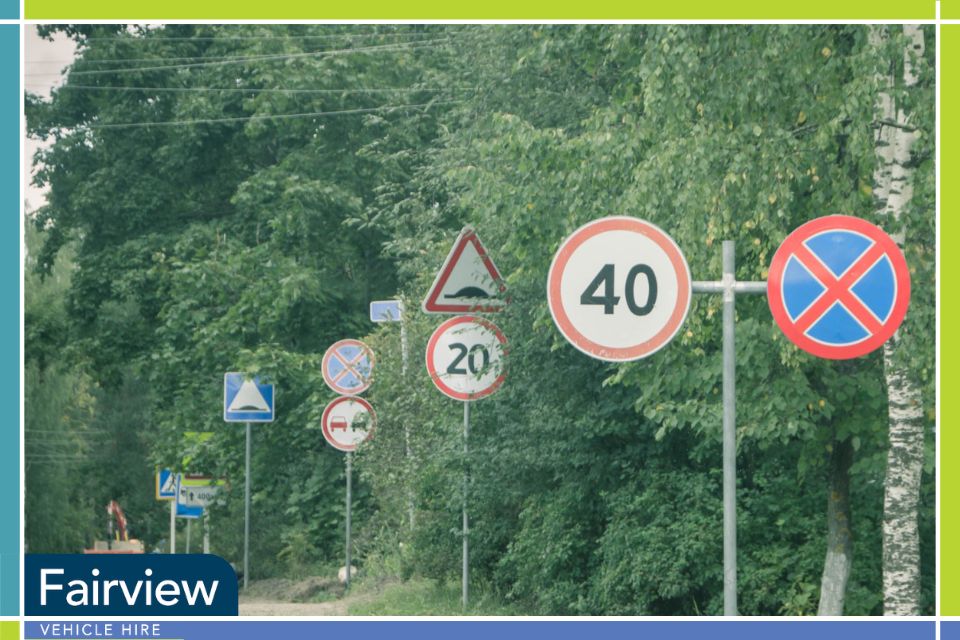
Speed Limits: A number inside the red circle shows the maximum speed limit in miles per hour (mph).

No Entry: A solid red circle with a white horizontal bar means no vehicles are permitted to enter that road.

No Waiting/No Stopping: A red circle with a blue background and a red X or diagonal lines means you cannot stop or wait in that area (often equivalent to double red/yellow lines on the road).

No Vehicles: A plain red circle means no vehicles of any kind, including cars and bicycles, are allowed beyond that point.

Action Prohibitions: A red circle with a black arrow pointing right that is crossed out by a bold red diagonal slash. This means vehicular traffic is prohibited from turning right at that junction (intersection).

Blue circles tell you what you must do.
In the UK, a blue circular road sign gives a positive, mandatory instruction. It tells you what you must do or indicates that there is a designated route.
Depending on the symbols inside, a blue circle can mean:
Directions or Mandatory Lane: An arrow shows the only direction you are legally permitted to travel. It forces you to change into or stay in that specific lane because it leads exclusively in the direction shown.

Minimum Speed Limits: A number inside the sign indicates the minimum speed you must maintain.

Restricted Routes: A bicycle, bus or pedestrian symbol shows that the route or lane is reserved exclusively for that type of road user.

2. Warning Signs (Triangles)
In the UK, triangle road signs warn you about potential hazards ahead, most often so you can slow down or prepare for changing road conditions.
A triangle road sign with a red border can signal sharp bends, junctions ahead or school crossings.
Depending on the symbol inside, a red-bordered triangle can signal:
Junctions and Roundabouts: These warn you that you are approaching a roundabout or junction, helping you anticipate changes in traffic flow and change lanes if needed.

Road Bends and Hazards: warn you about changes to the road ahead, such as sharp bends, narrow roads or steep hills, so you can adjust your speed in advance.

Vulnerable Road Users and Animals: These warn drivers to look out for pedestrians, cyclists or wildlife that may cross or share the road.

3. Information & Direction Signs (Rectangles)
Rectangle road signs in the UK inform you about directions, distances and route information. The background colour of these signs tells you exactly what kind of road you are currently driving on:

| Background Color | Meaning |
| Blue | Blue signs give directions on motorways |
| Green | Green signs give directions on primary routes such as A roads |
| White (with black border) | White signs cover local routes and add detail beneath other signs |
| Brown | Brown signs point to tourist attractions (zoos, historic castles and theme parks) |
| Yellow | Yellow signs mark roadworks and diversions |


Temporary Road Signs
Temporary road signs are used during roadworks, emergencies or special events.
They may indicate:
- Roadworks ahead
- Temporary speed limits
- Diversions
- Lane closures
- Temporary traffic signals
These signs are often yellow or use portable frames, making them easy to spot.

What Do Speed Limit Signs in the UK Mean?
Speed limit signs in the UK always show miles per hour. This catches drivers who are used to kilometres out, especially on unfamiliar roads where 60 can feel surprisingly fast. A number inside a red circle sets the maximum speed. A number inside a blue circle sets a minimum speed, which you will occasionally see in tunnels.
The sign that confuses international drivers most is the national speed limit sign. It is a white circle with a black diagonal stripe and no number at all. It does not mean the road has no limit. It means the standard national limit applies for your road type and vehicle:

- 30mph in towns and cities across England, Scotland and Northern Ireland
- 20mph on most restricted roads in Wales
- 60mph on single carriageways
- 70mph on dual carriageways and motorways
These limits apply to cars and motorcycles. Vans and larger vehicles have lower limits on most roads.
- Vans and goods vehicles (under 7.5 tonnes): 50 mph on single carriageways and 60 mph on dual carriageways.
- Vehicles towing a caravan or trailer: 50 mph on single carriageways and 60 mph on dual carriageways.
Motorway Road Signs
Many UK motorways use electronic overhead signs that can change depending on traffic, weather or incidents ahead.
Overhead gantries on smart motorways display variable limits that change with traffic conditions and cameras enforce them.

A red X above a lane means the lane is closed and you must not drive in it.
Arrows show which lanes are open or which lane you should move into.
Electronic message signs provide live updates about delays, accidents or roadworks ahead.

Which UK Traffic Signs Confuse Visitors the Most?
Give way
An upside-down triangle with a red border. It replaces the yield sign used in many countries. Slow down and let traffic on the main road pass before you pull out.
Stop
The familiar red octagon. You must stop completely at the solid white line even when the road looks clear.
No stopping
A red cross over a blue circle marks a clearway. You cannot stop at all, not even to drop off a passenger.
No waiting
A single red stripe over a blue circle. You can stop briefly to load or unload but you cannot park and leave the vehicle.

No motor vehicles
A motorcycle above a car inside a red circle. Many visitors read this as vehicles are allowed. It means the opposite.

Priority signs
Narrow stretches use paired arrows to show who goes first. The red arrow always marks the traffic that must give way. A blue rectangle with a large white arrow means you have priority.

Mini roundabout
A blue circle with three white arrows. Treat it like any roundabout and give way to traffic approaching on your right.
What Do UK Road Markings Mean?
Alongside road signs, it’s important to understand UK road markings before you arrive as well. The colour and pattern tell you what is allowed.
- Double yellow lines mean no parking at any time. You can pause to drop someone off, but you cannot leave the vehicle.
- Single yellow lines mean no parking during the hours shown on a nearby plate. Outside those hours, you can usually park unless other restrictions apply.
- Red lines mark red routes in London and some other cities. Stopping is banned during their operating hours and double red lines apply around the clock.
- Zigzag lines appear at pedestrian crossings and outside schools. Never stop or park on them.
- Double white lines run along the centre of the road. When the line nearest you is solid, you must not cross it to overtake.
- Yellow box junctions are painted grids at busy junctions. Do not enter the box unless your exit is clear. The one exception is waiting to turn right when only oncoming traffic holds you up.
- Give-way markings are painted triangles and broken white lines across your lane. They mean give way to traffic on the road ahead.
Cameras enforce many of these UK road markings, particularly box junctions and red routes in London. Read our UK driving rules guide to understand road markings and parking in the UK in more detail.
Which Road Signs Do You Need to Know When Driving in London?
London uses signs and markings that might not appear anywhere else in the UK. If you plan on hiring a car in London, these are the ones that you need to know about.
Congestion Charge signs
A white C inside a red circle marks the boundary of the charging zone in central London. Enter during operating hours, and you must pay the daily charge on the TfL website.

ULEZ signs
Green and white signs mark the Ultra Low Emission Zone, which covers most of Greater London. Vehicles must meet emission standards or pay a daily charge. Our guide to what ULEZ means for drivers explains it in full, and our team can confirm your hire vehicle meets the standard when you book.

Red routes
Red lines replace yellow ones on major London roads. Stopping on them almost always ends in a penalty charge captured on camera.

Bus lanes
Check the hours on the blue sign before using it. Outside the stated hours, you can normally drive in them. During the stated hours, cameras enforce them strictly.

Ready to Drive in the UK?
Once you know your UK road signs, the next step is choosing your vehicle. Fairview Vehicle Hire operates across London and the South East with branches at Heathrow, London City Airport, Battersea, Kensington, Egham and Bray. Choose a car, van, minibus or electric vehicle to hire and our team will happily talk you through any questions about signs, ULEZ or the congestion charge before you set off.
Explore the full fleet or contact the team to book your vehicle today.
UK Road Sign FAQs
Are UK road signs in miles or kilometres?
All UK road signs show speeds in miles per hour and distances in miles or yards. Kilometres never appear on British signs, so drivers used to metric speeds should get comfortable with the conversion before setting off.
Are road signs different in Wales and Scotland?
Road signs in Wales are bilingual and show Welsh before English. Wales also uses a default 20mph limit on most restricted roads, whereas England keeps 30mph. Parts of Scotland display place names in both English and Gaelic. The shapes, colours and meanings stay the same across the whole of the UK.
Do I need to pass a test on UK road signs to hire a car?
No test is required to hire a vehicle in the UK. You need a valid licence, and some overseas licences also need an International Driving Permit. Drivers remain responsible for any fines or charges picked up during the hire, so learning the key signs before arrival saves money as well as stress.
Where can I see every UK road sign in one place?
The official Highway Code traffic signs section lists all UK traffic signs with their meanings, and the government guide Know Your Traffic Signs explains nearly every sign you will encounter on British roads. Both are free to read online and are useful before your first UK road trip.